Rie Osei is beginning to look less like an artist waiting for her moment and more like one deliberately constructing it.
In a recent one-on-one conversation on Luv FM’s Oseikrom Top 10 Chart Show, the Ghanaian singer opened up about her music, creative direction and the journey behind the artist audiences are increasingly beginning to notice.
What stood out was not simply the fact that Rie had secured another media appearance. It was the sense of clarity behind the conversation.
In an industry where emerging artists can easily become trapped between chasing visibility and trying to define themselves, Rie appears to be taking a different route and allowing the music, the identity and the story to develop together.
Her rise has been gradual, but increasingly intentional.
With a sound that moves comfortably between Afrofusion, R&B, neo-soul and rap, Rie Osei is not positioning herself as another artist trying to fit neatly into Ghana’s existing musical categories. Her appeal lies partly in that ambiguity. She can be soulful without becoming predictable, rhythmic without abandoning songwriting, and contemporary without sounding like she is desperately following whatever is trending.
That identity has become particularly evident through records such as “Problem” and “Simon Says.”
“Simon Says,” in particular, represents a more revealing side of the artist. The record leans into alternative R&B territory, giving Rie room to explore vulnerability, attitude and sensuality without sacrificing her individuality.
But perhaps the more interesting story is what happens outside the records.
Rie’s recent movements suggest an artist gradually expanding her cultural footprint. From live performances to media appearances and carefully considered visual presentation, the strategy appears to be less about flooding the market and more about creating reasons for people to pay attention.
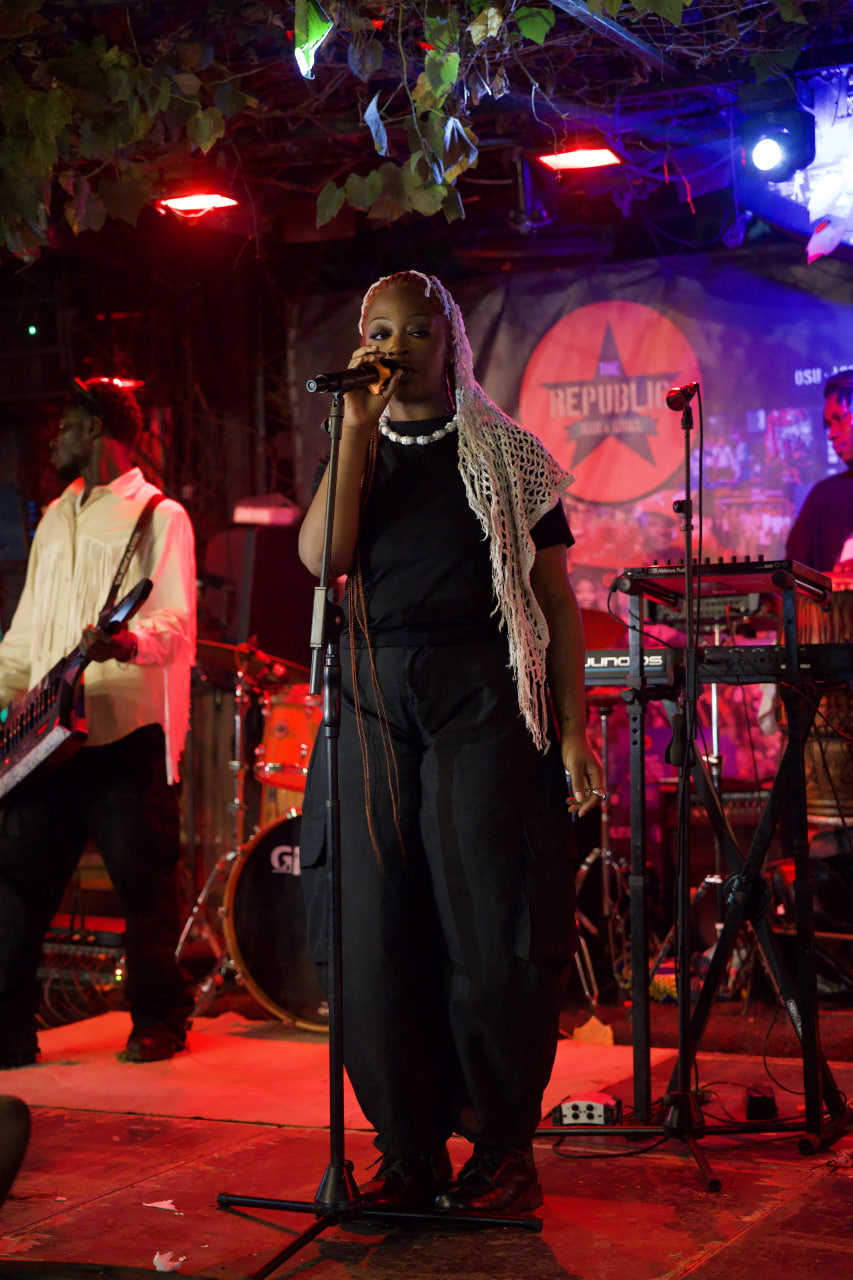
Her recent performance at Republic Bar & Grill in Osu reinforced that point.
In a room that has hosted some of Ghana’s most influential musical and cultural figures, Rie shared the stage with a live band and delivered a performance that placed her musicianship rather than a backing track at the centre of the experience.
The significance of moments like these is easy to underestimate.
For an artist at her level,, every performance is effectively an audition not necessarily for a record deal, but for the next opportunity, the next audience, strengthening her core fan base,the next collaborator and the next person capable of opening a door.

And Rie appears to understand that.
Her Luv FM appearance therefore feels like another piece of a much larger picture.
There is a growing curiosity around who Rie Osei actually is beyond the songs. That curiosity is valuable. In today’s attention economy, an artist’s story can become as important as the record itself.
The challenge now is converting that curiosity into sustained cultural relevance.
Ghana has no shortage of talented singers. What separates the artists who endure from those who briefly trend is usually not talent alone. It is identity, consistency, positioning and the ability to make audiences feel that they are watching something develop in real time.
Rie Osei seems to be entering that stage of her career.
She is still building.
Still experimenting.
Still finding new rooms to enter.
But the difference is that the rooms are beginning to notice her.
And if the trajectory continues, the conversation around Rie Osei may soon shift from “Who is she?” to a much more interesting question:
“How far can she actually go?”